



Markets do remain overvalued across the investment part
of the economy and we may see normalisation in some of
these segments.
We remain bullish on equities from a
medium to long term perspective.
Investors are suggested to have their asset
allocation plan based on one's risk appetite and
future goals in life.
|
Indian equities ended the month higher supported by strong festive demand, easing
global trade tensions and better than expected earnings so far. At its highest level in
October, the Nifty 50 was around 150 odd points away from its all time highs. The BSE
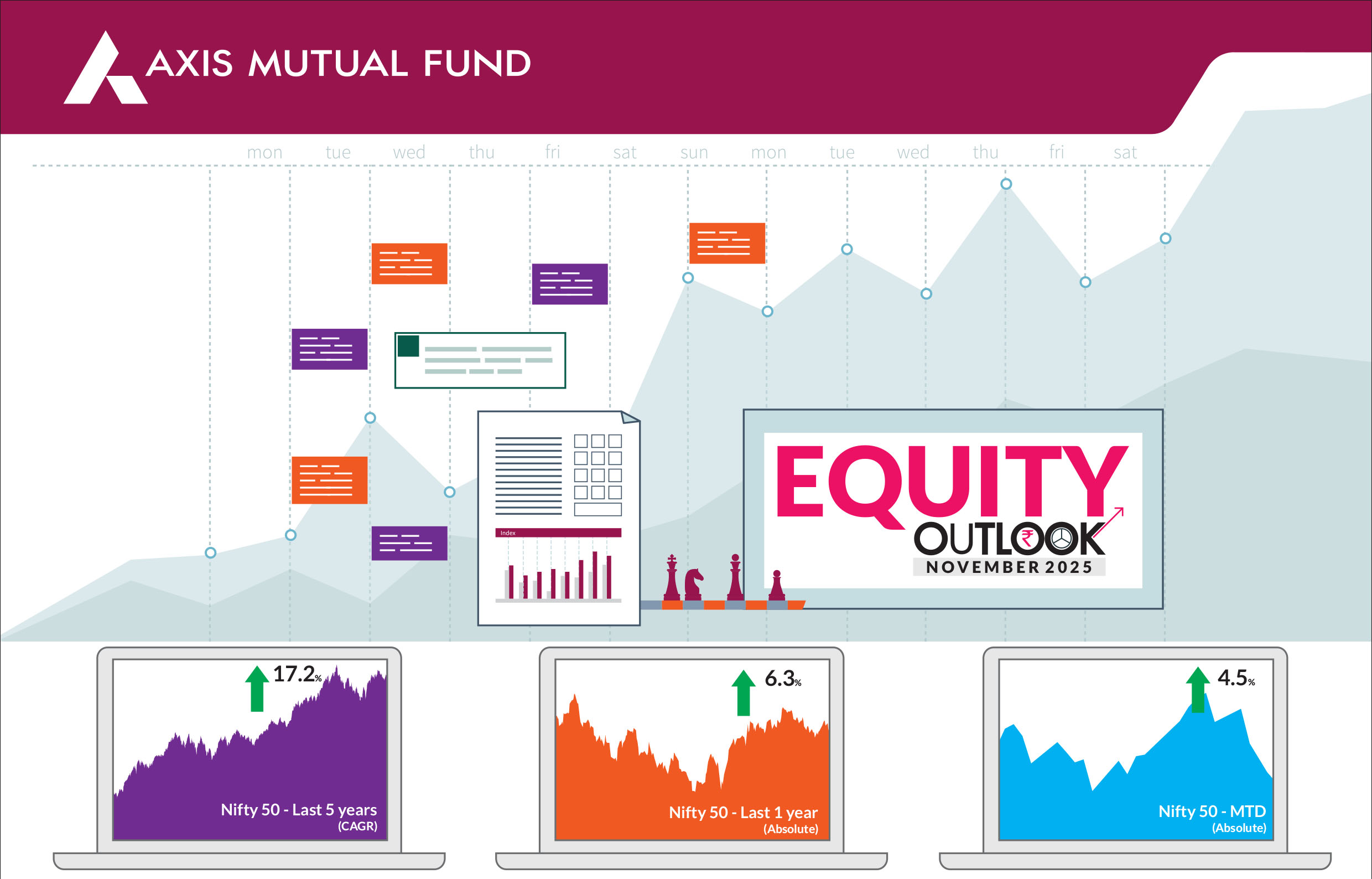
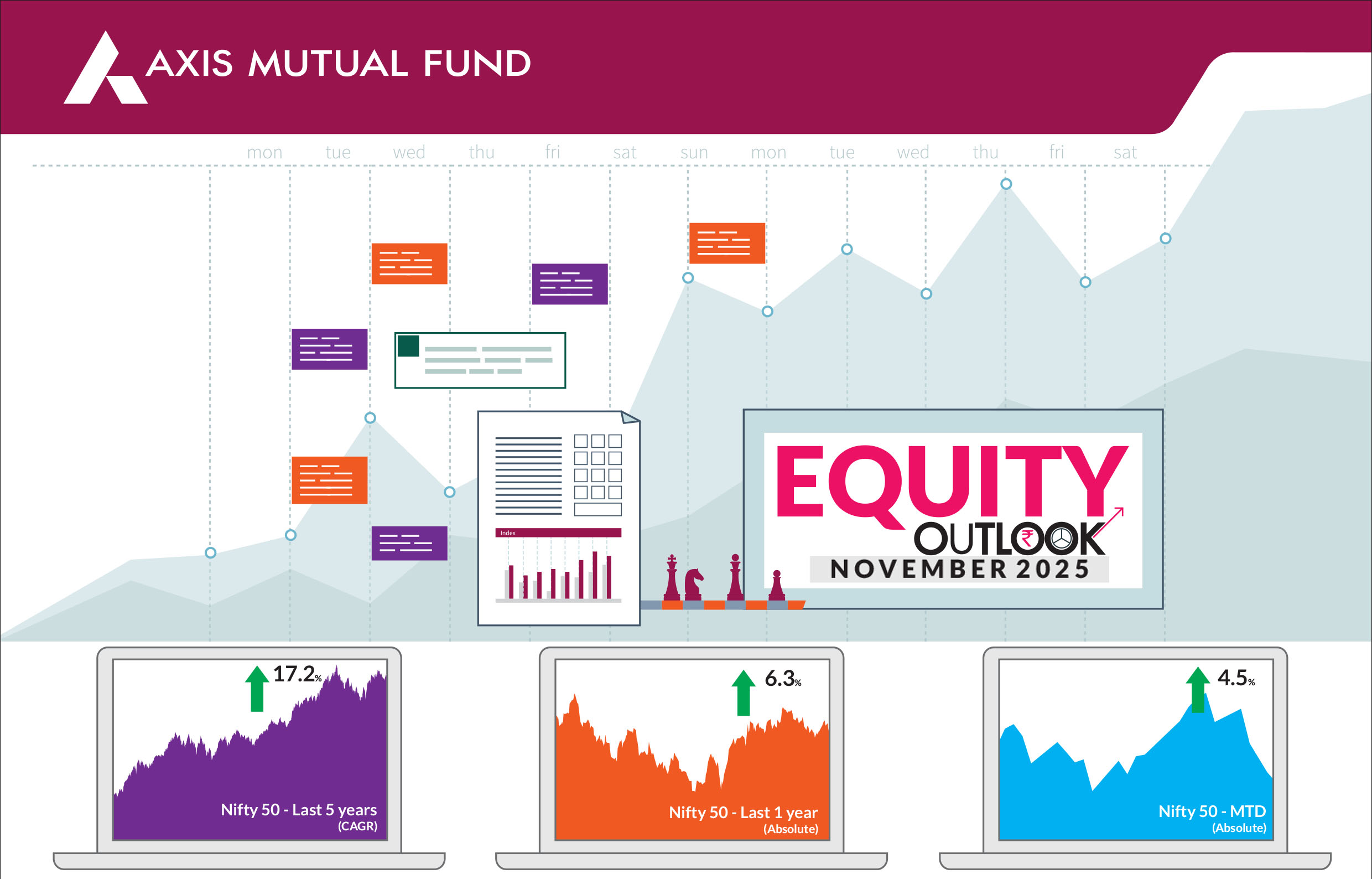
Sensex and Nifty 50 ended the month with gains of 4.6% and 4.5%, respectively. The mid
and small-cap indices outperformed, with the NSE Midcap 100 rising by 5.8% and NSE
Smallcap 100 gaining by 4.7%. At a sector level, realty, IT and oil & gas indices ended
higher in a month where all sectors delivered positive returns. Meanwhile, after three months of outflows, Foreign Portfolio Investors (FPIs) bought equities to the tune of US$1.7bn while Domestic Institutional Investors (DIIs) remained supportive with US$5.9bn in equity purchases. Year to date, FPI outflows total US$16bn while the DIIs bought to the tune of US$72.7bn. |
|
Key highlights of the month Better than expected earnings : 95 companies in BSE200 have reported results for Q2FY26 so far, accounting for 55% of BSE200 market cap. By sector, IT services, bank, NBFC, and staples are mostly out with their numbers, but many companies in auto, telecom, healthcare, NBFC, and chemicals are yet to report. For reported companies, Q2 sales growth picked up to +8.1% YoY vs 5.2% in Q1. Ex-energy/metals, growth was better at 9.8% YoY, though lower than 9.0% in Q1. All sectors have reported YoY growth in sales so far, led by consumer discretionary, auto and cement.Lenders are benefiting from cyclical recovery, digital adoption, and well-contained credit costs. Banks delivered a broadly in-line quarter, with most banks reporting modest credit growth, modestly higher-than-expected NIMs and broadly stable asset quality and large banks seeing signs of stabilization in their unsecured book. Downstream oil players are supported by firm refining margins, stable marketing economics, and softer crude prices, which enhance cash flow and dividend visibility. In consumer tech, festive demand, disciplined unit economics, and operating leverage continue to drive structural growth. IT services companies witnessed some stabilization in growth in 2QFY26, while margins held up broadly. However, IT services companies maintained a cautious outlook, given continued headwinds of a challenging macro environment and growing disruption risks. Overall, the tone of results and management commentary reinforces confidence in India's mid-cycle expansion story. |
|
Trade negotiations impasse : Progress on the India-US trade deal has renewed optimism
around export diversification and supply-chain realignment in India's favor, particularly
in electronics, pharmaceuticals, and engineering goods. A successful conclusion could
unlock greater market access for Indian exporters, reduce tariff-related uncertainties,
and encourage global firms to deepen manufacturing and sourcing partnerships with
India across high-value sectors. Equity Supply continues to surge : Equity supply remained strong with US$49bn yearto- date and US$6 billion in October alone, supported by a robust IPO pipeline. While absorption has been steady so far, the accelerating pace of issuance could start testing market depth. Overall, while the market has digested recent supply, the combination of elevated valuations and rising fundraising intensity may create near-term pressure on equities particularly if earnings delivery remains uneven. Valuations off high, premium to EM falls : Given the runup in October, valuations have again come up. Valuations continue to trade at least one standard deviation above longterm averages in the case of large and midcap and two standard deviation in the case of small caps. On a relative basis, India's premium to global and emerging markets is off higher levels. Yet, India remains one of the most expensive markets globally, only trailing the US. Outlook & Positioning The earnings season has exceeded expectations so far, indicating that the earnings cycle may be approaching a bottom. Festive demand for discretionary products has been strong, though its sustainability in the coming months remains a key monitorable. As we near the end of 2025, the primary macro concern continues to be the unresolved impasse over a favorable trade agreement for India.Against this backdrop, we maintain an overweight stance on consumption. The robust festive demand underscores the positive impact of GST rationalization. If macro tailwinds continue to flow through to end consumers, India's consumption cycle could reset meaningfully. Companies across consumer durables and automobiles have reported strong festive-season sales. We also remain constructive on other consumer discretionary plays-especially in retail, hospitality, and travel & tourism-which are poised to gain from strengthening domestic momentum. In the past two months, we have increased exposure to automobiles on the back of GST reforms and companies in this space have swiftly passed on the benefits to consumers. The trend toward premiumization is expected to strengthen, supported by a pickup in the replacement cycle. We anticipate that aspirational product segments will benefit more due to higher demand elasticity. While improved affordability will encourage first-time buyers, we believe the revival in replacement demand-muted in recent years-will be a more significant growth driver for passenger vehicles. We are overweight NBFCs within financials as these are well-positioned to benefit from increased credit demand and improved liquidity conditions. Furthermore, we are overweight pharmaceuticals; the US tariff measures in pharma are directionally progressing with current US government stance suggesting little or no implication for generic companies with some negative implication for innovator or branded products companies. We remain underweight in IT given the cautious environment in the US. Additionally, we are positive on structural themes such as renewable capex, power transmission, and defense. Overall, India continues to offer a compelling medium- to long-term growth opportunity, supported by resilient domestic demand, a favorable rural outlook post-monsoon, and supportive macroeconomic indicators. |
Source: Bloomberg, Axis MF Research.
